Northwest Fly Tyer & Fly Fishing Expo, 3/12-13, Albany, OR
Western Coastal Cutthroat Colition Study
Our Story
Draft Study Plan Summary: Association Between Cutthroat and Shellfish Aquaculture in Samish Bay Background
Knowledge of cutthroat movement patterns as they transition from residency at nearshore beaches to spawning in freshwater is growing; however, limited information exists for more exposed beaches like those in Samish Bay, and there is a lack of information for areas outside South Puget Sound. This leaves numerous unanswered questions important for the management of this native salmonid and for those using the nearshore habitat for commercial purposes, such as shellfish aquaculture.
Emerging science suggests that Coastal Cutthroat Trout (Oncorhynchus clarkii clarkii) lend themselves to studies of spatio-temporal movement patterns in the nearshore marine environment. Relative to other salmonids native to Washington and British Columbia, juvenile coastal cutthroat trout spend a significant amount of time in estuaries (Quinn 2024), exhibit high site fidelity for nearshore beaches (Losee et al. 2018), and can be considered an indicator species of nearshore habitat quality.
Study Goals
Over 1 year, this study will compare the movement behaviors of individual fish in bays with and without shellfish aquaculture using surgically implanted tags in the saltwater form of Coastal Cutthroat Trout. Each tag will emit a unique high-frequency sound (69khz) that can be detected and recorded by nearby acoustic receivers. The aims of this study are to 1) describe marine movement patterns of coastal Cutthroat trout in and around shellfish aquculture sites of Samish Bay and 2) describe temporal patterns of inter-habitat (freshwater, estuarine, nearshore) movements to inform best practices for commercial shellfish growing.
Study Area and Fish Collection
We will capture and acoustically tag 30 adult cutthroat trout in Samish Bay, using a beach seine and/or hook and line. Exact beach locations and timing of collections will be informed by local anglers, fish biologists or shellfish farm staff. Acoustic receivers will be deployed across the study area to detect movement patterns across divert habitat types and shellfish growing methods. In addition to fish movements, each receiver will collect temperature data from the surrounding environment to better understand how temperature influences cutthroat movements and habitat use.
Tagging Methods
Cutthroat greater than 180 mm fork length will be tagged in the field in April through October of 2026 with Vemco V9-6L acoustic tags (high power, 210 s delay, battery life 569 days). Specifically, they will be anesthetized with MS-222 (0.07 g/L) and supported upside down by a closed-cell foam block during surgery or held with electronarcosis gloves during the procedure. After an incision is made in the abdomen forward of the pelvic girdle muscle, a tag will be inserted, and the incision will be sutured with 2 stitches (4-0 RB-1 Taper antibacterial Ethicon Vicryl Plus violet braided). Weight and length will be recorded, and fin clip and scale samples will be collected.
Pictures of equipment used in acoustic telemetry study; Acoustic transmitters (e.g. tags), VRT2x acoustic receiver and example of on-site surgery station.
Figure 2. Map of Samish Bay, in North Puget Sound, Washington State. Colored polygons represent diverse shellfish growing operations and areas of interest for Cutthroat Tracking Project.
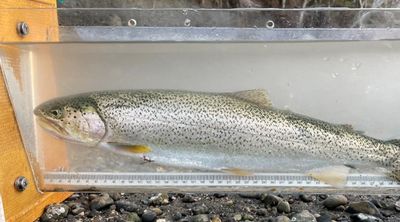
Figure 3. Photo of a sea-run cutthroat trout tagged with an acoustic transmitter with visible incision posterior to the pectoral fin.
2025 Clear Water Creek Restoration Project
Clear Water Creek Restoration Project
Clear Water Creek - A team of bush backers, organized by Hugh Lewis, cleared and restored safe access to the Clear Water Creek near Mt. Baker, a magical small stream.
The group of four set out for a half-day, hands-on trail maintenance, armed with saws, mattocks, pruners, and spades. The trail was indeed heavily overgrown and boggy in sections, but by noon, they had cleared the most troublesome parts of the
roughly half-mile stretch. Projects like this one reflect the spirit and commitment of 4th Corner members in supporting and preserving our natural surroundings.

Why Conservation?
Conservation is highly valued by the 4CFF. We understand and appreciate the value of protecting our fisheries and are dedicated to the protection and reservation of those fisheries when and if they are threatened. We financial support specific environmental organizations who protect our fisheries, actively participate in conservation efforts through research and governmental lawmaking. Actively participating in conservation projects and educational activities is for the betterment and preservation of angling waters, surrounding land, and aquatic resources.

Past Conservation Projects
- Fishtrap Creek, - This started as a project with one of the local high schools, planting a mix of bare root, potted and live staked plants along the creek teamed with a NSEA crew.
- TU DNA Project - Club members seined for baby fish from the waters and tributaries of the Nooksack River, placed then in an identification and measurement instrument, then released collecting data for the project.
- Cedar Grove - Cedar Grove can currently enjoy a newly built foot trail that winds through the forest and access the shore of the Skagit River. In the near future this trail will be made into a loop enhanced by several benches and an interpretive sign.
- Deer Creek - Tributary to Ten Mile Creek in Whatcom County. Planted and placed tree protection on 50 evergreen trees in November 2023. On going work project on conservation easement with oversight from NSEA.
- Little Deer Creek, (tributary of the Stillaquamish River). The 4CFF provided environmental and stream restoration.
.
- Nesset Creek, (tributary of the Nooksack River). The 4CFF provided environmental and stream restoration.
- Boyd Creek Interpretive Salmon Center, (tributary of the Nooksack River). In cooperation with the National Forest Service the 4CFF provided environmental and stream restoration-an outdoor classroom site built by 4th Corner Fly Fishers.
- Squalicum Lake, (county “Fly Fishing Only Lake”). The 4CFF acts as stewards for the launch site and maintains a creel census station constructed by the members.
- 10 Mile Creek, (tributary of the Nooksack River). Over a ten year period provided restoration and maintenance of the creek which flowed across the property of Irene Reither Elementary School to create an outdoor science classroom and partnered with Nooksack Salmon Enhancement Association who installed interruptive signs.
- Nooksack River eDNA Project, 4CFF supported the project as a financial supporter and provided volunteers to collect samples for the Bull Trout and Dolly Varden Aquatic Environment DNA Study. https://www.northsoundtu.org/dna.html
- Lily Point Marine Reserve, (located at Point Roberts). The 4CFF provided volunteer efforts for removal of invasive species and collection of beach trash.
- Smith Creek, (tributary of the Nooksack River). 4CFF provided volunteer work for the planting of native vegetations, giving shade for returning steelhead.
